
HTML Describes the Structure of Pages

You can see an HTML code Below. If you Don't understand Than Don't worry, remember we just started our journey.
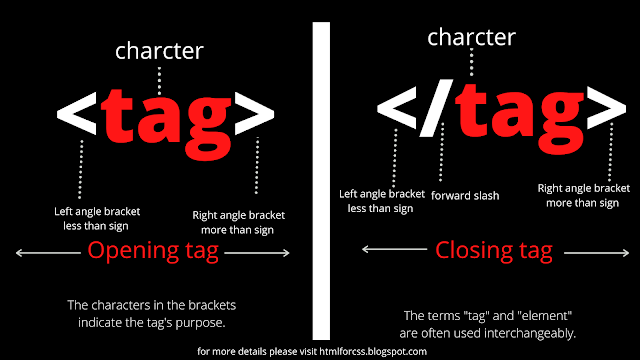

There are two types of tags. one is opening tag and one is closing tag.in the code you see red and yellow text that called tags. All red tags are opening tags and all yellow are closing tags.

CODE
 <html>
<body>
<h1>This is main heading</h1>
<p>This text might be an introduction to the  rest of the page. And if the page is a long one it might be split up into several sub-headings.</p> 
<h2>This is a sub-heading </h2>
<p>Many long articles have sub-headings. so to help you follow the structure of what is being written, There may even be sub-sub-heading(or lower-level headings).</p>
<h2>This is another sub-heading</h2>
<p>here you can see another sub-heading.</p>
</body>
</html>
For more blogs related to technology you can visit Relatetechno.codes

Comments

Popular posts from this blog

HOW PEOPLE ACCESS THE WEB

" THE MAIN FACTORS THAT ARE IMPORTANT IN ACCESS THE WEB 1. BROWSER In order to view a web page, users might type a web address into their browser. 2. WEB SERVERS When we requested a web page, the request sent to a computer known as the webserver which hosts the website. 3. DEVICE It is important to remember that various devices have different screen sizes and some have faster connections to the web than others. 4. SCREEN READERS Screen readers are the program that read out the content of a computer screen to a user. They are commonly used by people with visual impairment. Thanks for visiting my blog. I will try to post regularly. For more blogs related to technology you can visit Relatetechno.codes

HEADINGS AND PARAGRAPHS

HEADINGS: <h1> <h2> <h3> <h4> <h5> <h6> There are six levels of headings. <h1> is used for main headings <h2> is used for subheadings If there are further sections under the subheadings then the <h3> element is used, and so on... Browsers display the contents of headings at different sizes. The contents of an <h1> element are the largest, and the contents of an <h6> element are the smallest. The exact size at which each the browser shows the headings can vary slightly. Users can adjust the size of the text by using CSS. HEADING LEVELS PARAGRAPHS: To create a paragraph, surround the words that make up the paragraph with an opening <p> tag and closing </p> tag. By default, a browser will show each paragraph on a new line with some space between it and any subsequent paragraphs. paragraph next> Bold & italic and scripts(sub&super) Enjoy  😀 For more blogs related to technology you can visit Rela...

structure of page

SRUCTURE OF PAGE  HTML CODE  <html> <head>           <title> This is the Title of the Page </title> </head> <body> <h1> This is the Body of the Page </h1> <p> Anything within the body of a web page is displayed in the main browser window. </p> </body> </html> RESULT BODY, HEAD, TITLE <body> Anything within the body of a web page is displayed in the main browser window. <head> Before the <body> element you will often see a <head> element. This contains information about the page (rather than information that is shown within the main part of the browser window that is highlighted in blue on the opposite page). You will usually find a <title> element inside the <head> element. <title> The contents of the <title> element are either shown in the top of the browser, above where you usually type in the URL of the page you want to visit, or o...