
Line Breaks & Horizontal Rules

Line Breaks & Horizontal Rules


<br/>

As you have already seen, the browser will automatically show each new paragraph or heading on a new line. But if you wanted to add a line break inside the middle of a paragraph you can use the line break tag <br/>.
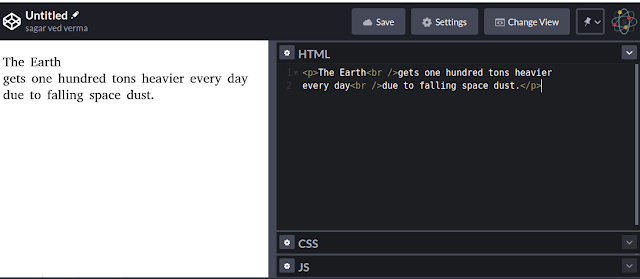
line break


<hr/>

To create a break between themes — such as a change of topic in a book or a new scene in a play — you can add the horizontal rule between sections using the <hr /> tag.

                                horizontal rule


There are a few elements that do not have any words between an opening and a closing tag. They are known as empty elements and they are written differently. 

An empty element usually has only one tag. Before the closing angled bracket of an empty element, there will often be a space and a forward slash character. Some web page authors miss this out but it is a good habit to get into.

next> semantic markup

Enjoy 


Comments

Popular posts from this blog

HOW PEOPLE ACCESS THE WEB

" THE MAIN FACTORS THAT ARE IMPORTANT IN ACCESS THE WEB 1. BROWSER In order to view a web page, users might type a web address into their browser. 2. WEB SERVERS When we requested a web page, the request sent to a computer known as the webserver which hosts the website. 3. DEVICE It is important to remember that various devices have different screen sizes and some have faster connections to the web than others. 4. SCREEN READERS Screen readers are the program that read out the content of a computer screen to a user. They are commonly used by people with visual impairment. Thanks for visiting my blog. I will try to post regularly. For more blogs related to technology you can visit Relatetechno.codes

summary For Structure

Summary HTML pages are text documents. HTML uses tags (characters that sit inside angled brackets) to give the information they surround special meaning. Tags are often referred to as elements. Tags usually come in pairs. The opening tag denotes the start of a piece of content; the closing tag denotes the end. Opening tags can carry attributes, which tell us more about the content of that element. Attributes require a name and a value. To learn HTML you need to know what tags are available for you to use, what they do, and where they can go. For more blogs related to technology you can visit Relatetechno.codes

ATTRIBUTES

ATTRIBUTES TELLS US MORE ABOUT ELEMENTS Attributes provide additional information about the contents of an element. They appear on the opening tag of the element and are made up of two parts: a name and a value , separated by an equals sign. HTML5 allows you to use uppercase attribute names and omit the quote marks, but this is not recommended. Attribute example 1 More about Attributes  The attribute name indicates what kind of extra information you are supplying about the element's content. It should be written in lowercase. The value is the information or setting for the attribute. It should be placed in double-quotes. Different attributes can have different values. Here an attribute called lang is used to indicate the language used in this element. The value of this attribute on this page specifies it is in US English. The majority of attributes can only be used on certain elements, although a few attributes (such as lang ) can appear on any element. Most attribute values are ...